Keiju in English
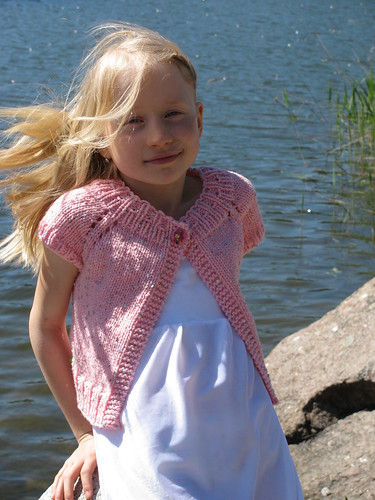
Keiju (finnish word for fairy) is top-down knit bolero with raglan sleeves and one button fastening.

|
84 kommenttia
|
Keiju in English15.07.2011 - 00:40
Keiju (finnish word for fairy) is top-down knit bolero with raglan sleeves and one button fastening.
Size: to fit about 120-130 cm tall child.
Finished measurements: length - about 33 cm (13 inches), bust - about 64 cm (25 inches), sleeve measured from the neckline - about 16 cm (6 1/4 inches).
Yarn: Novita Kide in pink (513), 2 balls = 200 gramms.
1 button, about 2,5 cm (1 inch) in diameter.
Needles: 6.0 mm (US10) circular needle, DPNs of the same size for knitting the sleeves, if prefered.
Gauge: 15 sts and 21 rows in 10 cm (4 inches).
Note! If you'd like to learn Estonian cast on, check out my video on flickr (short version) or YouTube (longer version). Don't mind the fact, that I am speaking Finnish, just follow the moves :D
Yoke
Cast on 72 sts using Estonian cast on or long tail cast on. Purl one row (WS).
Row 1: k4, *k1, p2*, repeat *-* untill 5 sts left, k5.
Row 2: k4, *p1, k4*, repeat *-* untill 5 sts left, p1, k4.
Rows 3-4: knit as rows 1-2.
Inc row: k4, *k1, p1, m1 by picking up the yarn between two sts of the previous row and purling (NB! do not purl tbl), p1*, repeat *-* untill 5 sts left, then make a buttonhole: k2, yo, ssk, k1. 93 sts in total.
Next row (WS): k4, *k1, p1*, repeat *-*, p1, k4 in the end of the row.
Knit in established pattern - 4 sts of garter sts on both edges and k1, p1 ribbing between them - for 4 more rows. When knitting the last row, place stitch markers as follows: 18 sts (right front), sm, 14 sts (right sleeve), sm, 29 sts (back), sm, 14 sts (left sleeve), sm, 18 sts (left front).
After that start raglan increases. Continue knitting in st st, except for 4 sts edges in garter st.
Work increases by knitting to one sts before sm, yo, k1, slip sm, k1, yo, knit to one st before next sm, yo, k1, slip sm, k1, yo etc. Make increases in every third row total of 6 times. Work 5 rows even in established pattern. 141 sts total.
Body
In the next row divide for body and sleeves as follows: knit to the first sm, slip 28 sts to stitch holder or waste yarn to wait, cast on 8 sts, knit sts of the back, slip 28 sts of the other sleeve to holder or piece of yarn, cast on 8 sts, knit to the end. Place sm under the sleeve to indicate right and left side "seam".
Work even for about 4 cm.
Inc row: knit to 1 st before sm, yo, k1, slip sm, k1, yo, knit to 1 st before next sm, yo, k1, slip sm, k1, yo, knit to end of row.
Work even for about 5 cm (2 inches).
When work measures about 9 cm (3½ inches) from armhole, work one more increase row in the same manner as the first one. 109 sts in total.
Continue working even.
When piece measures about 15 cm (6 inches) fron armhole, start working in ribbed patter as follows: k4, *k1, p3*, repeat *-* untill 5 sts left, k5. Work in established pattern 3 more rows.
After that work 6 rows of k1, p1 ribbing with 4 sts of garter st on both edges.
Bind off all sts.
Sleeves
Slip 28 sts from holder/waste yarn back to the circular needle or DPNs if prefered. Pick up 10 sts over the gap under the sleeve. Knit one row. Work 4 rows in k1, p1 ribbing. Bind off all sts. Work second sleeve in the same manner.
Weave in loose ends, sew on a button.
Keiju05.06.2011 - 12:27
Keiju on ylhäältä alaspäin neulottu raglanhihainen bolerojakku, joka kiinnitetään yhdellä napilla.
![]() Koko: noin 120-130 cm.
Lanka: Novita Kide, vaaleanpunaista (513) 2 kerää.
Puikot: 6.0 mm 60-80 cm pyöröpuikko ja 6.0 mm sukkapuikot hihoja varten.
Muut tarvikkeet: 1 iso nappi.
Luo 72 silmukkaa ja neulo yksi kerron oikein (nurjan puolen kerros). Neulo seuraava kerros näin: 4 o, *1 o, 2 n* kunnes puikolla on jäljellä 5 silmukkaa, 5 o.
Nurjan puolen kerros: 4 o, *1 n, 2 o* kunnes puikolla on jäljellä 5 silmukkaa, 1 n, 4 o.
Neulo samalla tavalla - 4 ainaoikein molemmassa reunassa ja 1 o, 2 n joustinta reunojen välissä - vielä 2 krs.
Lisäyskerros: 4 o, *1 o, 1 n, tee yksi silmukka nostamalla kahden nurjan silmukan välissä oleva poikkilanka ja neulomalla nurin (huom! ei kiertäen), 1 n*, toista **, neulo kunnes puikolla on jäljellä 5 silmukkaa. Tee sitten napinläpi: neulo 2 o, lk, 2 o yhteen takareunoistaan, 1 o. Puikolla on nyt 93 silmukkaa.
Nurjan puolen kerros: 4 o, *1 n, 1 o*, toista **, neulo kerroksen loppuun 1 n, 4 o.
Neulo 1 o, 1 n joustinneuletta yhteensä 6 kerrosta lisäyskerros mukaanlukien. Muista reunasilmukat ainaoikein. Kun neulot reunuksen viimeistä kerrosta laita työhön silmukkamerkit näin: 18 s (=etukappale), sm, 14 s (=hiha), sm, 29 s (=takakappale), sm, 14 s (=hiha), sm, 18 s (=etukappale).
Aloita sitten raglanlisäykset.
Pääntien reunuksen jälkeen jatketaan sileällä neuleella, reunukset neulotaan edelleen ainaoikein.
Tee lisäykset neulomalla langankiertoja yhden silmukan päässä silmukkamerkeistä, eli näin: neulo yhden silmukan päähän ensimmäisestä silmukkamerkistä, tee lk, neulo 1 o, siirrä silmukkamerkki, 1 o, lk, neulo yhden silmukan päähän seuraavasta silmukkamerkistä, 1 lk, 1 o, siirrä sm, 1 o, lk etc.
Tee lisäykset tällä tavalla joka 3. krs:ssa yhteensä 6 kertaa. Sen jälkeen neulo vielä 5 kerrosta ilman lisäyksiä. Työssä on 141 silmukkaa.
Seuraavassa kerroksessa jätetään hihojen silmukat apulangalle odottamaan: neulo etukappaleen silmukat, siirrä silmukkamerkien välissä olevat hihan 28 silmukkaa apulangalle, luo niiden tilalle 8 silmukkaa, neulo takakappaleen silmukat, siirrä toisen hihan silmukat apulangalle, luo niiden tilalle 8 silmukkaa ja neulo lopuksi toisen etukappaleen silmukat. Laita seuraavassa kerroksessa silmukkamerkit molemmalle sivulle keskelle hihan alle. Työssä on nyt 101 silmukkaa.
Kun olet neulonut noin 4 cm, tee sivuissa lisäykset neulomalla langankiertoja silmukkamerkkien molemmalla puolella yhden silmukan päässä silmukkamerkistä. Toista lisäykset vielä kerran kun työn korkeus on noin 9 cm. Työssä on 109 silmukkaa.
Kun työn korkeus on noin 15 cm kainalosta mitattuna aloita joustinneule työn oikealta puolelta näin: 4 o, *1 o, 3 n*, toista **, neulo kerroksen loppuun 5 o. Neulo 1 o, 3 n -joustinneuletta yhteensä 4 krs. Neulo sen jälkeen vielä 6 krs 1 o, 1 n -joustinta reunasilmukoiden sisällä. Päätä silmukat joustinta neuloen.
Hihat
Ota hihan 28 silmukkaa apulangasta sukkapuikoille. Poimi hihan alta vielä 10 silmukkaa. Neulo näillä 38 silmukalla yksi kerros oikein. Neulo sen jälkeen 4 kerrosta 1 o, 1 n -joustinta ja päätä silmukat joustinta neuloen.
Päättele langanpäät, kiinnitä nappi.
![]() Stockholm-Helsinki19.02.2011 - 21:41
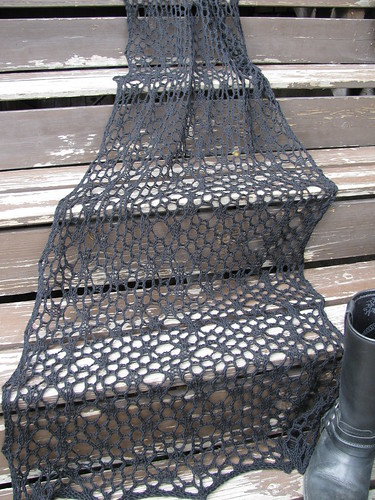
Tämän huivin tekemiseen olen saanut inspiraatiota Stockholm-huivista, jonka on suunnitellut knittedblissJC. Stockholm-huivin ohje löytyy hänen blogista ja on myös ladattavana Ravelryn kautta. Minun versiossa mallikuvio on muutettu hieman yksinkertaisemmaksi, silmukkamäärä on muutettu sopimaan paksummalle langalle ja päättelytapa on erilainen.
In making these scarves I was inspired by Stockholm scarf by knittedblissJC. Original pattern can be found at her blog and is available as Ravelry download.
In my version the pattern is a little simpler, stitch count is ajusted to suit bulkier yarn, and cast off technique is different. Scroll down for knitting instructions in English.
![]() ![]() Neulontaohje
Minä olen käyttänyt:
raidalliseen huiviin Gedifra Living -lankaa 3 kerää harmaanruskeaa ja 2 kerää vihreää.
vaaleanpunaiseen huiviin Novita Isoveli -lankaa vähän yli 3 kerää (320 grammaa).
Molemmat huivit on tehty 6.0 mm puikoilla.
Valmis huivi on noin 130 cm ympärysmitaltaan ja on noin 26-27 cm korkea.
Luo 200 silmukkaa neuloen. Ensimmäisen kerroksen jälkeen yhdistä renkaaksi ja jatka suljettuna neuleena.
1. krs: *3 o, 2 n*
2. krs: *nosta 1 s neulomatta, 2 o, vedä nostettu silmukka neulottujen yli, 1 n, lk, 1 n*
3. krs: *2 o, 3 n*
4. krs: *1 o, lk, 1 o, nosta 1 s neulomatta HUOM! lanka silmukan edessä, 2 n, vedä nostettu silmukka neulottujen yli*
Toista kerroksia 1-4 kunnes työ on noin 26 cm korkea ja olet viimeiseksi neulonut mallineuleen 3. krs.
Päättely: *1 o, lk, vedä neulottu silmukka langankierron yli, 1 o, yliveto, 1 n, yliveto, 1 n, yliveto, 1n, yliveto*.
Jos tuntuu, että yläreunasta tulee liian kireä ylimääräisistä silmukoista huolimatta (langankierrot oikeiden silmukoiden välissä), ota päättelyä varten paksummat puikot.
Knitting instructions
I have used:
for striped scarf 5 balls of Gedifra Living
for pink scarf a little over 3 balls (320 g) of Novita Isoveli
Both scarves are knit with 6.0 mm (US10) circular needles.
Finished scarf measures about 130 cm in circ. and 26-27 cm in height.
psso - pass slipped stitch over
pkso - pass knit sititch over
ppso - pass purled stitch over
Cast on 200 sts using knitted cast on method. After the first row join work into circle and continue working in a round. Be carefull not to twist.
Row 1: *k3, p2*
Row 2: *s1, k2, psso, p1, yo, p1*
Row 3: *k2, p3*
Row 4: *k1, yo, k1, s1 with yarn in front, p2, psso*
Repeat rows 1-4 untill work measures about 26 cm (about 10 inches) and the last worked row is 3rd row of a pattern.
Binding off: *k1, yo, pass slipped stitch over yo, k1, pkso, p1, ppso, p1, ppso, p1 ppso*. If it looks like the bind off edge is too short despite extra stitches (yarn overs), try using larger needle or the cast off technique used in original pattern.
Not Pretty22.09.2010 - 15:42
Tämä huivi on suunniteltu olemaan ruma. Joten pieni virhe siellä sun täällä ei haittaa ollenkaan, päinvastoin! Lanka:
Kuvassa oleva huivi on neulottu 100 % merinovillasta BBB Filati Martine (50g = 144m), 60x140 cm kokoiseen huiviin tarvitset 3½ kerää tätä tai vastaavaa lankaa.
Puikot:
5.0 mm tai käsialan mukaan, tiheydellä ei ole kovin paljon merkitystä tässä työssä.
Työohjeet:
Luo löyhästi 76 silmukkaa. Neulo 4 kerrosta ainaoikein.
Aloita pitsineule kaavion mukaan niin, että neulot ensin 2 reunasilmukkaa, toistat sitten mallikerran 24 silmukkaa (kaaviossa silmukat 3-24) 3 kertaa ja neulot lopuksi viimeiset 2 reunasilmukkaa. Neulo kaavion kerrokset 1-28, ja sen jälkeen toista kerrokset 5-28 kunnueshuivin pituus on sopiva. Neulo lopuksi 4 kerrosta ainaoikeaa. Päättele silmukat.
Viimeistely:
Kastele huivi hyvin viileässä vedessä, purista vesi pois. Venytä muotoon ja kiinnitä nuppineuloilla tasaiselle alustalle. Huivia ei tarvitse pingottaa suorakaiteen muotoiseksi, neula sinne tänne on parempi kuin hyvä, kunhan pitsi aukeaa kunnolla. Ei haittaa, jos pitsi näyttää epätasaiselta ja aukot erikokoisilta, näin on vain parempi :)
![]() This shawl is designed to be ugly. So couple of mistakes here and there don't make it worse, just the opposite!
Yarn:
Shawl in the photo is knit with 100 % merino BBB Filati Martine (50g = 144m = 158 yards), I used 3½ skeins for 60x140 cm large shawl.
Needles:
5.0 mm (US 8) or the size you prefer, gauge is not important.
Working instructions:
Loosly cast on 76 sts. Work 4 rows in garter stitch.
Start working in lace pattern according to chart. Work 2 edge sts of chart, then work 24 sts (stitches 3-24 in the chart) of lace pattern 3 times, and then 2 last edge sts. Work rows 1-28 of the chart once, after that continue working rows 5-28 untill shawl reaches desirable lenght. Work 4 rows in garter stitch. Cast off.
Finishing:
Soak in cool water, squeeze out the excess water. Pull shawl into shape, pin on smooth surface. Rectangular shape is not necessary, pin here and there work fine, as long as lace opens properly. Don't worry, if some holes are smaller than others and tension is not even, it's only better this way :)
![]() If you have any questions or comments about this pattern, feel free to contact me on Ravelry!
Chart is created with chartGen, big thanks for great knitting chart software!
30. Neulottu naisen jakku, ENG09.09.2010 - 17:42
Design by Novita team. Women's knitted jacket. This is a translation. The original pattern is published in Finnish in Novita Syksy 2009 and is available for free on their website. For the charts scroll down and click "näytä neulekaavat".
![]() Sizes available: XS(S)M(L)XL(XXL)
Ready garment measures
Across back: 42(46)50(54)58(62)cm
From neck to bottom: 52(55)58(60)63(66)cm
Sleeve inseam: 43(44)45(46)46(47)cm
Yarn: Novita 7 Veljestä (colourway 766) (aran weight, 150 g = 300 meters) 550(600)650(700)750(800)g
or Novita Rose Mohair (colourway 078) 200(250)300(350)400(450)g
Needles:
If using Novita 7 Veljestä 4-4½ mm and 5 mm needles or the size to obtain gauge.
If using Novita Rose Mohair 5 mm or 5½-6 mm needles or size to obtain gauge.
Gauge: 18 sts and 25 rows in stockinette stitch in 10 cm (4").
Stockinette stitch: knit on RS, purl on WS.
Textured pattern: work according to chart.
Hem piece measures about 30(32)34(36)38(40) sm slightly stretched.
Back: using smaller needles cast on 76(82)90(98)104(110) sts and work in stockinette for 3 rows. Bind off 3(3)3(3)4(4) sts in the beginning of next 2 rows. After that continue decreasing for armholes by binding off sts in the beginning of every row as follows:
For size XS: bind off 1 st in next 8 rows. 62 sts remains.
For size S: bind off 2 sts in the beginning of next 2 rows, and 1 sts in the beginning of 8 following rows. 64 sts remains.
For size M: bind off 2 sts in the beginning of next 2 rows, and 1 sts in the beginning of 12 following rows. 68 sts remains.
For size L: bind off 2 sts in the beginning of next 4 rows, and 1 sts in the beginning of 12 following rows. 72 sts remains.
For size XL: bind off 2 sts in the beginning of next 4 rows, and 1 sts in the beginning of 12 following rows. 76 sts remains.
For size XXL: bind off 2 sts in the beginning of next 4 rows, and 1 sts in the beginning of 16 following rows. 78 sts remains.
Work even in stockinette untill your work measures 20(21)22(22)23(24) cm from beginning of armholes. Bind off all sts.
Sleeves: using smaller needles cast on 45(47)48(50)52(54) sts. Knit one row (WS). Start working in stockinette stitch. When sleeve measures 18 cm, increase by making one stitch in the beginning and end of following row. Repeat increases every 12(12)10(8)8(8) row 3(0)2(7)5(3) more times and after that every 10(10)8(6)6(6) row 1(5)4(0)3(6) more times. Total amount of sts after increases is 55(59)62(66)70(74) sts.
When work measures 43(44)45(46)46(47) cm, start decreasing by binding off stitches in the beginning of every row as follows: 2 times 3(3)3(3)4(4), 2(2)2(4)2(4) times 2 sts, 30(32)34(34)38(38) times 1 stitch and 2 times 3 stitches. Bind off remaining sts.
Hem: is worked flat sideways, see direction of knitting in the chart. Using larger needles cast on 54(57)59(62)64(67) sts and purl one row (WS). Start working according to chart. Work 1st row as follows: section A (=3sts), section B (=9(11)11(13)13(15) sts), section C (=12 sts), section D (=9(10)11(12)13(14) sts), section E (=14 sts), section F (=3(3)4(5)5(5) sts) and section G (=4 sts). Repeat rows 1-12 of the chart for sections A, B, C, E, F and rows 1-8 for section G. Slip first stitch of every RS row.
Attention! After working first 3 rows start working short rows as follows:
*RS row: work 34(37)38(41)42(45) sts in textured pattern according to the chart. Turn work, make yo, work all sts in pattern.
Next RS row: work 13(15)15(17)17(19) sts in pattern, turn work, make yo, work back.
Next RS row: work over all 54(57)59(62)64(67) sts, work yos as k2tog with the following stitch.
Work next 3 rows in textured pattern over all sts.*
Repeat ** (8 rows) untill left edge (=shorter, inside edge) measures about 116(124)132(138)146(154) cm. Leave sts on hold.
Assembling: sew sleeve seams (marked with red in the drawing 1). Attach sleeves to the back piece (marked with green). Using pins attach hem to the back and sleeves, pull slightly while pinning. Check that the lenght of the hem is right. Bind off sts.
Sew cast on and cast off edges together so, that hem forms a circle (marked with blue in the drawing 2). Sew hem to the back and sleeves as shows in drawing 3 (marked with red).
Note from translator! You might want to use provisional cast on for hem piece, this way you'll get much better looking seam. You might want to place seam under the arm to make it even more unnoticable.
Photo by Lilia. Dottie17.08.2010 - 17:09
![]() This is a simple trangular shawl knitted from the neck down. Leaf spine and gathered details make it interesting and somewhat cute :)
I used 3.0 mm (US2½) circular needles and about 837 meters (915 yards) = 135 gramms of Schachenmayr Nomotta Rheuma Thermal Wolle (100% wool, 50 g = 310 m) in very light mint green.
Gauge is not important for this project, and even if it was, I am not able to give you this information, as the shawl is no longer with me :)
The charts are hand made, I know they aren't pretty. But as some of you know, I am still (!) experiensing problems with my computer, so this is as good as it gets for now. You can understand it, right? That's the most important. I'll upload new charts later. At least I hope so ;)
Remember, if you don't like it, you don't need to knit it ;)
If you have any questions or comments, please feel free to contact me on Ravelry. Messages are most welcome!
So, here she comes - Dottie!
![]() Cast on 3 sts. You might want to use provisional cast on, but long tail cast on works as well.
Knit 12 rows.
Next row: k3, pick up and knit 7 sts along the long side of the knitted piece, pick up and knit 3 sts along cast on edge.
Row 2 (WS): k3, p1, k2, p1, k2, p1, k3.
Row 3 (RS): k3, yo, k1, yo, p2, k1, p2, yo, k1, yo, k3.
From now on, on the worng side work sts as they present, purl yos.
The pattern is now established. Work 3 first and 3 last sts of every row in garter stitch. Make 4 increases in every right side row by working 1 yo inside of edge sts, and 1 yo on the both side of central (leaf) pattern.
NB! Edge stitches and increases are not shown in the charts!
After first 4 rows, start leaf pattern on 5 central sts (p2, k1, p2) according to the chart 1. Notice, that the amount of sts is not the same in every row of leaf pattern. Work side sections in stockinette stitch.
To make it easier here are couple of next rows:
Row 5: k3, yo, k3, yo, p2, k1, p2, yo, k3, yo, k3.
Row 7: k3, yo, k5, yo, p2, k3 out of 1, p2, yo, k5, yo, k3.
Row 9: k3, yo, k7, yo, p2, k1, yo, k1, yo, k1, p2, yo, k7, yo, k3.
Continue working untill you've knit 39 rows of leaf pattern.
![]() Gathered stripe:
Work next 5 rows (starting with the wrong side row, row 40 of leaf pattern, last row of second leaf) as follows:
Work edge sts in garter stitch as before, work side panels sts in garter stitch, except for yarn overs (purl on wrong side), work central sts in leaf pattern. You'll have 3 ridges on the right side of the work after these 5 rows are complete.
Row 6: k3 (edge sts), yo, knit every stitch of side panel f&b (front and back of the stitch, making two sts out of one), yo, leaf pattern according to chart, yo, f&b every stitch of side panel, yo, k3.
Row 7 (WS): k3, purl to the central sts, work central sts in leaf pattern, purl to last 3 sts, k3.
Rows 8-15: work side panels in stockinette sts, remember to make increases on both sides.
Row 16 (RS): k3, yo, k4, *k2tog*, repeat till last 4 sts of side section, k4, yo, work leaf pattern; work left side the same way.
Rows 17-21: work side panels in garter sts as first 5 rows of gathered stripe.
You will now (most probably ;)) have 63 sts for each side panel.
Next 2 rows: work side palens in stockinette, work increases and leaf pattern as established.
Start eyelet pattern according to chart 2. Work rows 1-48 twice, after that work rows 1-3. Important! Read chart from right to left for both sides of the shawl, do not mirror.
![]() Make another gathered stripe starting with the WS row as the first one. At the same time make decreases according to chart 3 after 9th repeat of leaf pattern. Leaf pattern stitches are decreased to one stitch. Continue working this stitch as knit between yarn overs.
You should now have 185 sts for each side panel.
Edging:
Rows 1-10: work in stockinette stitch. 195 sts for each side panel.
Row 11: start working according to chart 4A for the right side and 4B for the left side of the shawl. Read both charts from right to left.
![]() Work rows 1-22.
Bind off all stitches, make sure the egde is loose and stretchy.
Soak in cool water, gently squeeze excess water out. I find it effective to wrap shawl into large towel, put it to the floor and step on it.
Block with pins on smooth surface, let dry completely. Weave in all ends. Wear with joy :)
![]() Pimpinella18.06.2010 - 20:24
Pimpinella
Tämä huivi muistuttaa kovasti perinteistä virolaista pitsihuivia. Huivi ei kuitenkaan ole ns. tyypillinen niskasta aloitettu kolmiohuivi, vaan se neulotaan alareunasta ylöspäin. Silmukoiden luomisessa saattaa mennä paljon aikaa (ja hermoja J), mutta eipä sitten tarvitse päätellä kuin 10 silmukkaa! Huivin nimi tulee juhannusruusun latinankielisestä nimestä Rosa Pimpinellifolia, koska huivin yläosan kuvio muistuttaa ruusunnuppuja. Muutenkin huivi tuo mieleen kukkia, kesän ja juhannuksen, varsinkin näin vaaleanpunaisena. Tämä huivi on suunniteltu erityisesti Anskulle, mutta toivon, että muillekin neulojille olisi tästä ohjeesta iloa ja hyötyä!
Lanka ja langanmenekkiteetee Kamena (100 g = 470 m, 100 % villaa), 2 vyyhtiä (joista tosi vähän jäljellä). Kuvassa väri 138. Puikot
Pyöröpuikot 3.5-4.0 mm käsialan mukaan, ainakin 80 cm pitkät. Kuvassa oleva huivi on neulottu 120 cm pitkillä 3.75 mm puikoilla. Voit vaihtaa lyhyempään puikkoon työn edetessä. NeuletiheysNeuletiheydellä ei ole suurta merkitystä. Jos haluat huivista ilmavamman ja isomman, käytä paksummat puikot. Huomion, että langanmenekki saattaa muuttua. Muut tarvikkeet
Jos haluat käyttää silmukkamerkkejä, voit laittaa niitä neulomisen helpottamiseksi siihen kohtaan, jossa kaaviossa on punainen pystyviiva. Koko
Huivin yläreuna on noin 210-215 cm pitkä. Huivin korkeus yläreunasta kärkeen on noin 100 cm. Ohje
Kaavion 1 jälkeen joka kerroksen aikana kavennetaan 4 silmukkaa. Huomaa, että reunapitsin (kaavio 2) kuviossa silmukkamäärä vaihtelee eri kerroksilla. Joka kerroksen alussa ja lopussa neulotaan 4 silmukkaa ainaoikein. Luo neuloen kaksinkertaisella langalla 473 silmukkaa. Katkaise toinen lanka ja jatka yksinkertaisella langalla kaavion 1 mukaan. Neulo oikeasta reunasta 4 s oikein, toista kaavion 16 silmukan mallikerta 29 kertaa, neulo kaavion viimeiset 5 silmukkaa oikein. Neulo kaavion 1 kerrokset 1-16 kerran. Kaavion 1 jälkeen työssä on 473 silmukkaa. Aloita kaavio 2: neulo 4 o, neulo mallikerran kavennusosio A, toista osio B (16-14 silmukkaa) 12 kertaa, neulo kavennusosio C, keskikuvion D 15-13 silmukkaa, kavennusosio E, toista osio F (16-14 silmukkaa) 12 kertaa, neulo kavennusosio G ja lopuksi 4 o. Toista kerrokset 1-24 yhteensä 3 kertaa. Kaavion 2 jälkeen työssä on 281 silmukkaa. Neulo sitten kaavion 3 mukaan näin: neulo ensin osio A, sitten toista osion B 12 silmukan mallikerta 8 kertaa, neulo osio C ja keskikuvio D, neulo sitten osio C peilikuvana, toista osion B 12 silmukan mallikerta 8 kertaa, ja lopuksi osio A peilikuvana. Neulo seuraavaksi kaavion 4 mukaan. Neulo ensin osio A niin, että toistat 10 silmukan mallikerran 7 kertaa, neulo sitten keskikuvio B ja sitten osio A peilikuvana. Toista osion A krs 1-10 ja osion B krs 1-8. Neulo näin 80 kerrosta. Neulo vielä 22 krs kaaviota 5 niin, että neulot ensin osion A, sitten osion B ja lopuksi osion A peilikuvana. Työssä on nyt 25 silmukkaa. 1. krs (OP): 4 o, 2 o takareunoistaan yhteen, käännä työ. 2. krs (NP): nosta 1 s neulomatta, 4 o. Toista kerroksia 1-2 vielä 5 kertaa. 6 silmukkaa kavennettu. Seuraava kerros (OP): 4 o, 2 o takareunoistaan yhteen, 13 o. 1. krs (NP): 4 o, 2 n yhteen, käännä työ. 2. krs (OP): nosta 1 s neulomatta, 4 o. Toista kerroksia 1-2 vielä 6 kertaa. 7 silmukkaa kavennettu, työssä on jäljellä 11 silmukkaa. Seuraava kerros (NP): 5 o, 2 o yhteen, 4 o. Jaa silmukat kahdelle puikolle (5+5) ja päättele kolmen puikon päättelyä käyttäen. Viimeistely
Katkaise lanka. Kastele huivi, puristele hyvin, mutta varovasti, levitä ja kiinnitä nuppineuloilla muotoon tasaiselle alustalle. Anna kuivua. Päättele langanpäät. Neulemerkit HUOM! Errata: kaavion yhteydessä merkkien selityksessä virhe! Poimittu silmukkaa neulotaan seuraavalla tavalla: neulo 3 oikein yhteen, mutta älä nosta pois vasemmalta puikolta, vaan ota lk puikolle ja neulo samat 3 silmukkaa yhteen toiden kerran. Nosta juuri neulotut silmukat pois vasemmalta puikolta. Silmukoiden määrä pysyy samana.
And the same in English, big thanks to Nefera for translation!
This shawl resembles a traditional Estonian lace shawl. However, the shawl is not a typical top-down triangular shawl, but rather it's knit from bottom up. Casting on the stitches may take some time (and nerves), but at least you only have to bind off 10 stitches! The name of the shawl originates from the latin name of burnet rose, Rosa Pimpinellifolia, as the top part pattern resembles rosebuds. Either way the shawl brings to mind flowers, summer and Finnish midsummer, especially in this pink of a colour. This shawl has been designed especially for Ansku, but I also hope other knitters would enjoy this pattern!
Yarn and yardage: teetee Kamena (100 g = 470 m, 100 % wool), 2 skeins (only a bit remaining). Colour in photos: 138. Needels: Circular needles 3.5-4.0 mm based on knitter's gauge, at least 80 cm in length. Shawl on the picture was knit with 120 cm long 3.75 mm circular needles. You may switch to shorter needles as the work progresses. Gauge: Gauge is not crucial. If you want a larger and a more airy shawl, use thicker needles. Please note that this may increase the yardage. Other tools: If you want to use stitch markers to make it easier to follow the pattern, you should place them where the pattern shows a vertical red line. Size: Top edge of the shawl measures at 210-215 cm. Height from top edge to tip is about 100 cm.
Instructions: After Chart 1, 4 stitches are decreased each row. Note, that during edge lace (Chart 2) the number of stitches varies between rounds. First and last 4 stitches of each round are knit to form a garter stitch edge. With two strands of yarn held together, cast on 473 stitches. Break off one of the strands, and continue knitting with a single strand according to Chart 1. Starting from right edge, k4, repeat 16 sts of Chart 1 29 times, k last 5 sts. Work through rows 1-16 of Chart 1 once. 473 sts on needles after Chart 1. Start chart 2: k 4 sts, work through decrease section A, repeat section B (16-14 sts) 12 times, work through decrease section C, 15-13 sts of middle section D, decrease section E, repeat section F (16-14 sts) 12 times, work through decrease section G, and finally k last 4 sts. Repeat rows 1-24 of Chart 2 for a total of 3 times. 281 sts remain after Chart 2. Knit according to Chart 3 as follows: First work section A, then repeat section B (12 sts) for a total of 8 times, work section C and middle section D, then work section C again as a mirror image, repeat the 12 sts of section B 8 times, and finally work section A as a mirror image. Next, work according to Chart 4. First, knit section A such that you repeat the 10 st wide section 7 times, then work section B, then section A as a mirror image. Repeat rows 1-10 of section A, and rows 1-8 of section B. Knit 80 rows as set. Finally, work through 22 rows of Chart 5: first knit section A, then section B, and finally section A again as a mirror image. 25 sts remain on needles.
Row 1 (RS): k 4, k2tog through back loops, turn.
Row 2 (WS): slip 1 st, k4.
Repeat rows 1-2 for 5 more times. 6 sts decreased.
Next row (RS): k4, k2tog through back loop, k13.
Row 1 (WS): k 4, p2tog, turn. Row 2 (RS): slip 1 st, k4.
Repeat rows 1-2 for 6 more times. 7 sts decreased, 11 sts remain.
Next row (WS): k5, k2tog, k4. Divide the remaining sts on two needles (5+5), bind off using three needle BO.
Finishing off: Break off yarn. Wet the shawl with water, squeeze out excess water well but gently. Block to shape and let dry. Weave in ends.
--------------------------------- Chart symbols explanation in the same order as on the blog: 1. k on RS, p on WS. 2. p on RS, k on WS. 3. YO. 4. k2tog. 5. SSK. 6. k3tog. 7. slip 1 st purlwise, k2tog, pass slipped st over. 8. double YO, on WS p first st, k second st. 9. k3tog, but do not drop from left needle, yo, knits same 3 sts together once again, drop worked sts from the left needle. The number on sts remains the same. 10. No stitch.
Vanamo21.02.2010 - 23:56
The original pattern in Finnish is published in Ulla 1/10. NB! You'll find the chart for colourwork and gusset increases behind that link!
As I was knitting these mitts I couldn’t stop thinking about this flower. Vanamo. Twin flower. Linnaea borealis. So delicate, so fragile. Tiny pale pink flowers and evergreen leaves. Little jewel of cool old forest, reminding us of ancient days.
SIZE Women’s S[M] (shown in size S). The pattern uses gauge changes to fit two sizes. FINISHED MEASUREMENTS Hand circumference: 6,5[7] inches unstretched Lenght: 9,5[10] inches MATERIALS [MC] ONLine Linie 155 Supercool [100 % merino superwash; 159 yd/145 m per 50 g skein]; color: #84; 1 skein Substitute yarn: Lana Grossa Cool Wool 2000 [100 % merino; 176 yd/161 m per 50 g skein]. Also known as Merino 2000 For size S: 1 set US #1½/2,5 mm double-point needles For size M: 1 set US #1½/2,5 mm double-point needles 1 set US #2/2,75 mm double-point needles GAUGE 34 sts/37 rows[32 sts/36 rows] = 4 inches in stockinette stitch PATTERN NOTES Braid: Round 1: *k1 in CC, k1 in MC, repeat from * to end of round. Wrap the next st: sl st, bring both yarns forward, replace sl st back onto left hand needle, turn. Wrong side is facing. Round 2: Pull out couple of yards of each yarn before start knitting this round. K1 in MC. *Pick up CC under MC, k1 in CC; pick up MC under CC, k1 in MC. Repeat from *. The yarns will be twisting around each other. Round 3: *Pick up CC over MC and k1 in CC; pick up MC over CC, k1 in MC. Repeat from *. The yarns will be untwisting as you work this round. End by wrapping one st as before. Turn work so right side is facing. The shaping of the thumb gusset and colorwork pattern have been presented in chart form. When working the thumb gusset, the chart must be mirrored for the back of the work. Light squares of the chart represent sts knit in MC. Filled squares represent sts knit with CC. There is one st knit in main color on both sides of the mitten between colorwork sections. These two sts are not in the chart. Positions of these seam sts are established in the first row of colorwork. PATTERN Cuff Using long tale cast-on and CC, cast on 56 sts onto larger DPNs. Join into round, be careful not to twist. Next round: knit all sts. Join MC. Make first braid. Next round: knit all sts in MC. Next round: *k2, p2, repeat from * to end. Continue to work in k2, p2 ribbing for 12 more rounds. Next round: knit all sts in MC. Begin colorwork Next round: *k1 in MC, work row 1 of chart across 27 sts, repeat from *. Continue to work in chart, remember to knit 1 st in MC as false seam st as established. Work the straight section of the chart – 29 rows. Thumb gusset Next round: work row 31 of the chart. Continue as set. Every second row of the chart is an increase round. There will be 20 sts increased. Thumb Next round: k1 in MC, work row 50 of the chart across 27 sts, place next 21 sts onto waste yarn for thumb. Cast on 1 st in MC using backward loop method, work row 50 of the chart across remaining 27 sts. Palm Continue to work as set until the end of chart. Break CC. Ribbing Switch to smaller needles. Next round: *k2, p2, repeat from * Continue to work in k2, p2 ribbing for 8 more rounds. Bind off all sts. Thumb ribbing For size S: Put thumb sts back onto 2 smaller DPNs. Using MC and new needle, pick up and knit 3 sts across the gap, knit all sts to end of round. 24 sts total. Distribute sts evenly onto 3 or 4 needles as you knit. Next round: SK2P, k1, *p2, k2* twice, p3tog, p1, *k2, p2* twice. 2o sts total, 4 sts decreased. Next round: *k2, p2, repeat from * to end of round. Continue working in k2, p2 ribbing for 8 more rounds. Bind off all sts. For size M: Put thumb sts back onto 2 smaller DPNs. Using MC and new needle, pick up and knit 3 sts across the gap, knit all sts to end of round. 24 sts total. Distribute sts evenly onto 3 or 4 needles as you knit. Next round: *k2, p2, repeat from * to end of round. Continue working in k2, p2 ribbing for 8 more rounds. Bind off all sts. Weave in all loose ends. Soak in cool water for 10-15 mintes, squeeze gently, roll in a towel to absorb excess water. Block with pins on a flat surface and let dry.
Pletenka23.10.2009 - 12:32
![]() The original cowl was made for my 10 years old son and it fits quite snuggly. For adult size add number of sts multiple of 6. For example, for wider cowl cast on 84 sts. It will add 6,5 cm/2,5 inches to width.
I don't recommend bigger needles for upsizing, unless you use heavier yarn.
This cowl is designed for boys and men, but I find it rather unisex now, when it's made :)
![]() Size: 40 cm/15 inches in circ. unstretched. Fits over 51-53 cm/20-21 inches head.
19 cm/7½ inches long.
Yarn: Novita Puro (100 % wool, 50 g = 100 m)
Needles: DPNs 5.0 mm/US8
Gauge: 18 sts and 12 rows in 10 cm/4 inches.
Important! Do not try to knit this cowl on circular needles. The wraps will tighten up around the string and sts will not move on your needles. Trust me, I know what I am talking about ;)
Important II! :) The beginning of the row will shitf by 3 sts every second row. You might want to use marker, but you can do without. You'll have to rearrange sts on your needles as you knit.
Important III! I am not quite happy with the upper edge of the cowl - "raw" cast on edge. So, if you have better ideas, please, use them :) I like the way cowl looks, when upper edge is turned inside (1-2 inches). Makes if look and feel soft and round near the face.
Cast on 72 sts. Join into round.
Row 1: knit all sts.
Row 2: insert needle into a next stitch as if to knit, wrap yarn around the needle counterclockwise 3 times, pull needle out of the stitch, slip just knit stitch from left hand needle. There should be 3 wraps on the right hand needle. Knit all remaining sts same way.
Row 3: *slip 6 sts from left hand needle to right hand needle, wraps will open. With the left hand needle slip 3 right most sts over 3 left most sts. You now have 3 long sts on your right needle, and 3 long sts on your left needle. Slip 3 sts from your right hand needle onto left hand needle. Make sure sts remain in order. Knit 6 sts.* Repeat ** till the end of row.
Row 4: work as row 2.
Row 5: slip 3 sts to the right hand needle, let wraps open. Place marker to indicate the beginning of the row. *slip 6 sts from left hand needle to right hand needle, let wraps open. Slip all 6 sts back onto left hand needle. With your right hand needle slip 3 left most sts over 3 right most sts. You now have 3 long sts on your right needle, and 3 long sts on your left needle. Slip 3 sts from your right hand needle onto left hand needle. Make sure sts remain in order. Knit 6 sts.* In the end of this row you'll have 3 long sts, that you slipped before placing marker. Treat them the same way as all other sts. Naturally, you don't have to slip them once again ;)
Row 6: work as row 2.
Row 7: slip 3 sts to the right hand needle, let wraps open. Place marker. *slip 6 sts from left hand needle to right hand needle, wraps will open. With the left hand needle slip 3 right most sts over 3 left most sts. You now have 3 long sts on your right needle, and 3 long sts on your left needle. Slip 3 sts from your right hand needle onto left hand needle. Make sure sts remain in order. Knit 6 sts.*
Continue working rows 4-7 untill work measures 18 cm (7 inches) from cast on edge.
Knit 3 rows, purl 1 row. Bind off sts. Block gently if desired. Enjoy wearing :)
![]() If you found some mistakes or if you have some questions about this pattern, please, feel free to contact me on Ravelry. Herne23.10.2009 - 00:30
![]() Koko
Päänympärys 50(54) cm.
Pienemmän pipon alareuna on noin 44 cm venyttämättömänä. Pipon korkeus on noin 18-19 cm.
Huom! Isomman koon silmukkamäärät perustuvat vain laskutoimituksiin. Pipoa ei ole koevirkattu isommassa koossa.
Lanka
Regia Cotton sukkalanka (41 % villa, 34 % puuvilla, 25 % polyamidi, 100 g = 400 m) noin 50-55 grammaa.
Koukku
3,25 mm (D) tai käsialan mukaan.
Tiheys
22 p x 16 krs = 10 x 10 cm resoria virkaten.
Lyhenteet
kjs - ketjusilmukka
ps - piilosilmukka
kpe - kohopylväs etukautta
kpt - kohopylväs takakautta
FDC - pohjapylväs. Video löytyy tästä.
kpe - virkkaa pylväs edellisen kerroksen pylvään varren ympäri etukautta: työnnä koukku edellisen kerroksen pylvään ympäri edestä-taakse-eteen.
kpt - virkkaa pylväs edellisen kerroksen pylvään ympäri takakautta: työnnä koukku edellisen kerroksen pylvään ympäri takaa-eteen-taakse.
Kuva kertoo enemmän kuin tuhat sanaa :)
Tässä esitellään, miten virkataan kaksi pylvästä yhteen. Kohopylväiden yhteenvirkkaaminen onnistuu samalla periaatteella.
Joka kerros alkaa 3 kjs:lla (=1 p), tätä aloituspylvästä ei mainita ohjeessa joka kerroksen kohdalla, vaan kuvio alkaa seuraavasta silmukasta.
Joka kerros yhdistetään piilosilmukalla, tätäkään ei mainita joka kerroksen kohdalla. Poikkeuksena resorin ensimmäinen kerros, jonka kohdalla on mainittu sekä aloituspylväs että piilosilmukka kerroksen lopussa.
![]() Luo 88(96) silmukkaa käyttäen FDC - ns. pohjapylväitä. Näin saat joustavan aloitusreunan. Yhdistä renkaaksi ps:lla. Pylväskerroksen alareuna jää auki, se suljetaan aloituslangalla viimeistelyvaiheessa.
Resori
3 kjs (= ensimmäinen pylväs tässä ja jokaisen seuraavan kerroksen alussa), *1 kpe, 1 kpt*, toista yhteensä 10(11) kertaa, 1 kpe. Yhdistä kerros ps:lla. Toista tätä riviä kunnes resori on 6,5 cm korkea tai haluamasi korkuinen.
Spiraalikuvio
1. krs: *1 kpe, 7 kpt* 10(11) kertaa, 1 kpe, 6 kpt.
2. krs: *2 kpe, 6 kpt* 10(11) kertaa, 2 kpe, 5 kpt.
3. krs: *3 kpe, 5 kpt* 10(11) kertaa, 3 kpe, 4 kpt.
4. krs: *4 kpe, 4 kpt* 10(11) kertaa, 4 kpe, 3 kpt.
5. krs: 1 kpt, *4 kpe, 4 kpt* 10(11) kertaa, 2 kpt.
6. krs: 2 kpt, *4 kpe, 4 kpt* 10(11) kertaa, 1 kpt.
7. krs: 3 kpt, *4 kpe, 4 kpt* 10(11) kertaa.
8. krs: 1 kpe, *4 kpt, 4 kpe*, 10(11) kertaa, 4 kpt, 2 kpe.
9. krs: 2 kpe, *4 kpt, 4 kpe*, 10(11) kertaa, 4 kpt, 1 kpe.
Jatka tällä tavalla; kuvio siirtyy joka kerroksessa yhden pylvään verran vasemmalle. Jatka kunnes pipo on 12 cm alareunasta mitattuna. Aloita silloin kavennukset.
Kavennukset
Kavennukset voi aloittaa missä tahansa kerroksessa. Muista jatkaa spiraalikuvion virkkaamista kavennusten aikana. Siirrä kohopylväsraitoja yhden pylvään verran vasemmalle joka kerroksessa, vaikka pylväiden määrä muuttuisi.
1. kavennuskerros: kavenna takakautta virkattujen pylväiden kohdalla näin: 1 kpt, 2 kpt yhteen, 1 kpt. Kerroksen aikana kaventuu 11(12) pylvästä - yksi pylväs jokaisen kpt-raidan kohdalla. Kpe-raidat pysyvät ennallaan (4 kpe per raita).
1. välikerros: ei kavennuksia, virkkaa kuvion mukaan, *4 kpe, 3 kpt*.
2. kavennuskerros: kavenna nyt jokaisen kpe-raidan kohdalla 1 pylväs näin: 1 kpe, 2 kpe yhteen, 1 kpe. Kerroksen aikana kaventuu taas 11(12) pylvästä.
2. välikerros: ei kavennuksia, kuvio on nyt *3 kpe, 3 kpt*.
3. kavennuskerros: kavenna joka kpt-raidan kohdalla näin: 1 kpt, 2 kpt yhteen.
3. välikerros: ei kavennuksia, kuvio on nyt *3 kpe, 2 kpt*.
4. kavennuskerros: kavenna joka kpe-raidan kohdalla näin: 1 kpe, 2 kpe yhteen.
4. välikerros: ei kavennuksia, kuvio on nyt *2 kpe, 2 kpt*.
5. kavennuskerros: kavenna joka kpt-raidan kohdalla virkkaamalla 2 kpt yhteen.
5. välikerros: ei kavennuksia, kuvio on *2 kpe, 1 kpt*.
6. kavennuskerros: kavenna joka kpe-raidan kohdalla virkkaamalla 2 kpe yhteen.
7. kavennusverros: *2 kpe yhteen*, toista kerroksen loppuun.
Työssä on nyt 11(12) silmukkaa. Katkaise lanka, pujota se jäljellä olevien silmukoiden läpi ja kiristä. Sulje aloituskerroksen alareuna aloituslangalla. Päättele langanpäät. Mitään erikoisempaa viimeistelyä ei tarvita. |